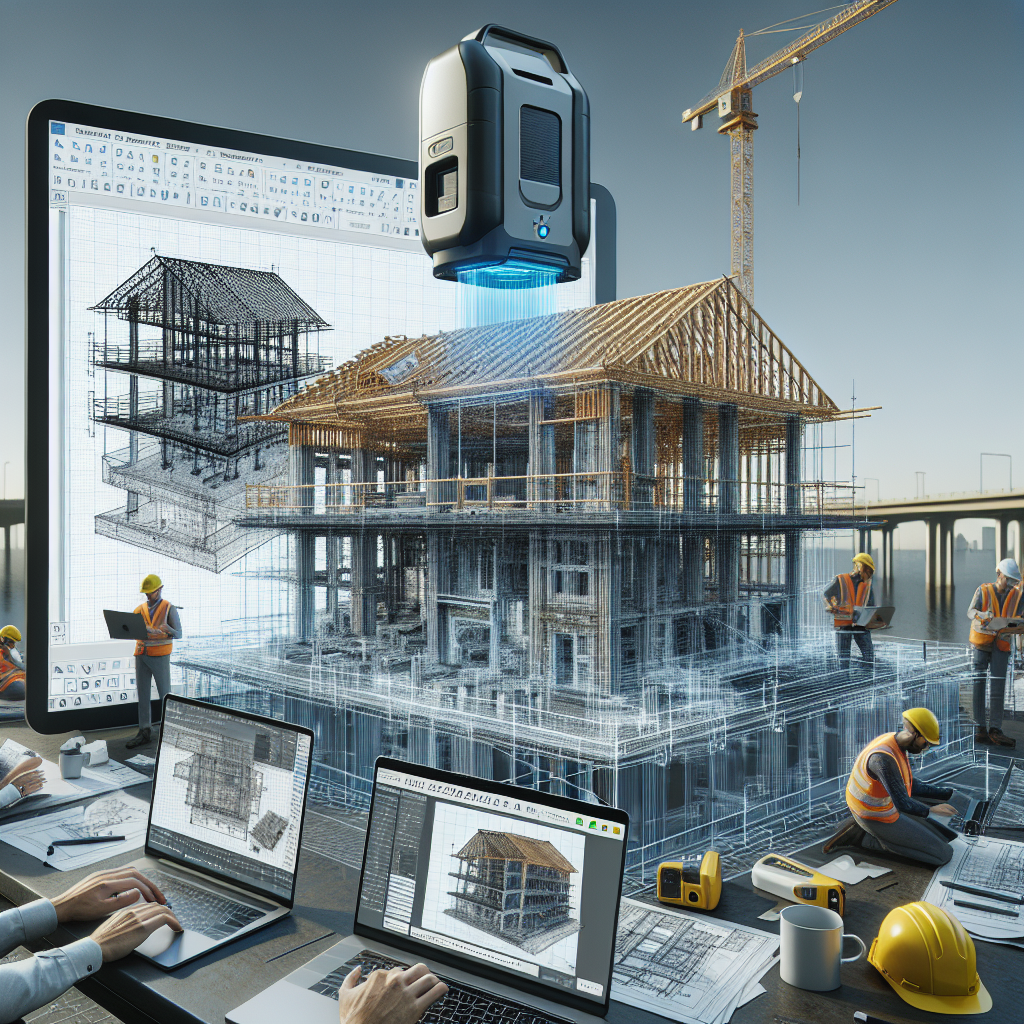
In the evolving landscape of architecture, engineering, and construction (AEC), integrating reality-capture technologies with Building Information Modeling (BIM) has become critical for project success. LOD-Based Scan to BIM—the process of converting laser scan data into detailed digital models at defined Levels of Development (LOD)—enhances efficiency, reduces errors, and provides precise documentation of existing structures. This integration is invaluable for renovations, maintenance, and new construction planning, as it streamlines workflows, minimizes rework, and supports data-driven decision-making. For AEC professionals, adopting this approach means leveraging actionable insights from physical spaces to optimize digital workflows, ultimately delivering cost-effective, accurate outcomes.
What is LOD-Based Scan to BIM and Why Does It Matter?
LOD-Based Scan to BIM bridges the gap between physical reality and digital representation by converting point cloud data from laser scanners or photogrammetry into BIM models structured by LOD specifications. Each LOD (e.g., LOD 200 for conceptual models, LOD 400 for construction-ready details) defines the model’s maturity, ensuring alignment with project phases. This methodology matters because it eliminates guesswork in as-built documentation, enabling clash detection, spatial coordination, and compliance with standards like ISO 19650. Unlike generic BIM workflows, LOD-based approaches explicitly quantify data granularity, reducing ambiguity during handoffs between architects, engineers, and contractors. For example, a surveyor’s scan data transformed into LOD 350 models allows a BIM coordinator to validate structural elements against design intent, preventing costly site discrepancies. This precision is especially vital for heritage renovations or retrofitting projects, where existing conditions are complex and undocumented.
Integrating Reality Capture with BIM for Renovation and Maintenance
Renovation and maintenance projects demand hyper-accurate existing condition data—a challenge traditional methods struggle to address. LOD-Based Scan to BIM solves this by capturing millimeter-accurate point clouds of existing structures, which are then processed into parametric BIM models. This integration supports clash-free MEP (mechanical, electrical, plumbing) retrofits, as seen in hospital refurbishments where new systems must align with legacy infrastructure. For instance, reality capture data can be imported into Revit or ArchiCAD to create LOD 400 models, enabling conflict identification before construction begins. According to industry research, this reduces rework by up to 30% and accelerates decision-making. Additionally, as-built LOD models serve as living digital assets for facility managers, streamlining maintenance workflows. Services like those offered by Arena CAD specialize in converting scan data into LOD-compliant BIM, ensuring seamless integration into project workflows for engineering teams.
How AI Enhances Scan to BIM Workflows
Artificial intelligence is revolutionizing scan-to-BIM processes by automating data interpretation and reducing manual effort. Unlike fears of job displacement, AI acts as a “capability multiplier,” as demonstrated by platforms like BuildOps in mechanical systems. For example, AI algorithms can automatically classify point cloud data—identifying walls, pipes, or ducts—saving hours of manual modeling. This mirrors how second-year technicians diagnose HVAC issues using context previously held only by veterans, translating to faster LOD model generation. Tools like Autodesk ReCap or Bentley ContextCapture paired with AI plugins (e.g., Pointcab for Revit) enable automated LOD 200–350 conversions. The result? Reduced human error and accelerated project timelines. For reality-capture specialists, this means less time on tedious data cleaning and more time on validation. As Enginyring.com integrates AI into their engineering workflows, these capabilities are becoming accessible for large-scale infrastructure projects, ensuring scalability and consistency.
Scaling Scan to BIM for Large Projects
Successful implementation of LOD-Based Scan to BIM hinges on scalable infrastructure and standardized workflows, mirroring principles from digital transformation in hospitality. Large-scale projects—such as airport terminals or multi-story developments—require centralized cloud platforms (e.g., Autodesk Construction Cloud) to store, process, and share scan-to-BIM data across teams. API-driven connectivity ensures interoperability between tools like FARO scanners and BIM software (e.g., Navisworks), enabling real-time clash detection. Standardization is equally critical: defining LOD thresholds early (e.g., LOD 300 for architectural models) ensures consistency across disciplines. This approach prevents the data silos that plague fragmented systems, as noted in industry analyses. For project managers, cloud-based solutions provide audit trails and version control, while modular workflows allow phased implementation—starting with LOD 200 for feasibility and advancing to LOD 400 for construction. By adopting these strategies, firms can scale scan-to-BIM across multiple sites without compromising accuracy—a core lesson from Arena CAD’s enterprise deployments.
Practical Steps for Implementing LOD-Based Scan to BIM:
- Define LOD Requirements: Specify LOD targets for each phase (e.g., LOD 100 for planning, LOD 400 for fabrication).
- Select Compatible Tools: Pair scanners (e.g., Leica RTC360) with BIM software (Revit, Tekla) supporting point cloud integration.
- Leverage Cloud Platforms: Use cloud storage (e.g., Trimble Connect) for centralized data access.
- Automate with AI: Integrate AI plugins for automatic point cloud classification and model generation.
Conclusion
LOD-Based Scan to BIM is no longer a niche practice but a cornerstone of modern AEC workflows, delivering unmatched accuracy and efficiency. By grounding projects in reality-capture data and structuring it through LOD standards, teams mitigate risks, enhance coordination, and drive cost savings. As AI and cloud technologies evolve, these workflows will become even more accessible and scalable. For firms investing in this approach—like those supported by Enginyring.com’s engineering services—the payoff is clear: fewer errors, faster timelines, and more resilient project outcomes. Embracing LOD-Based Scan to BIM isn’t just about technology adoption; it’s about redefining how we translate physical spaces into digital value.