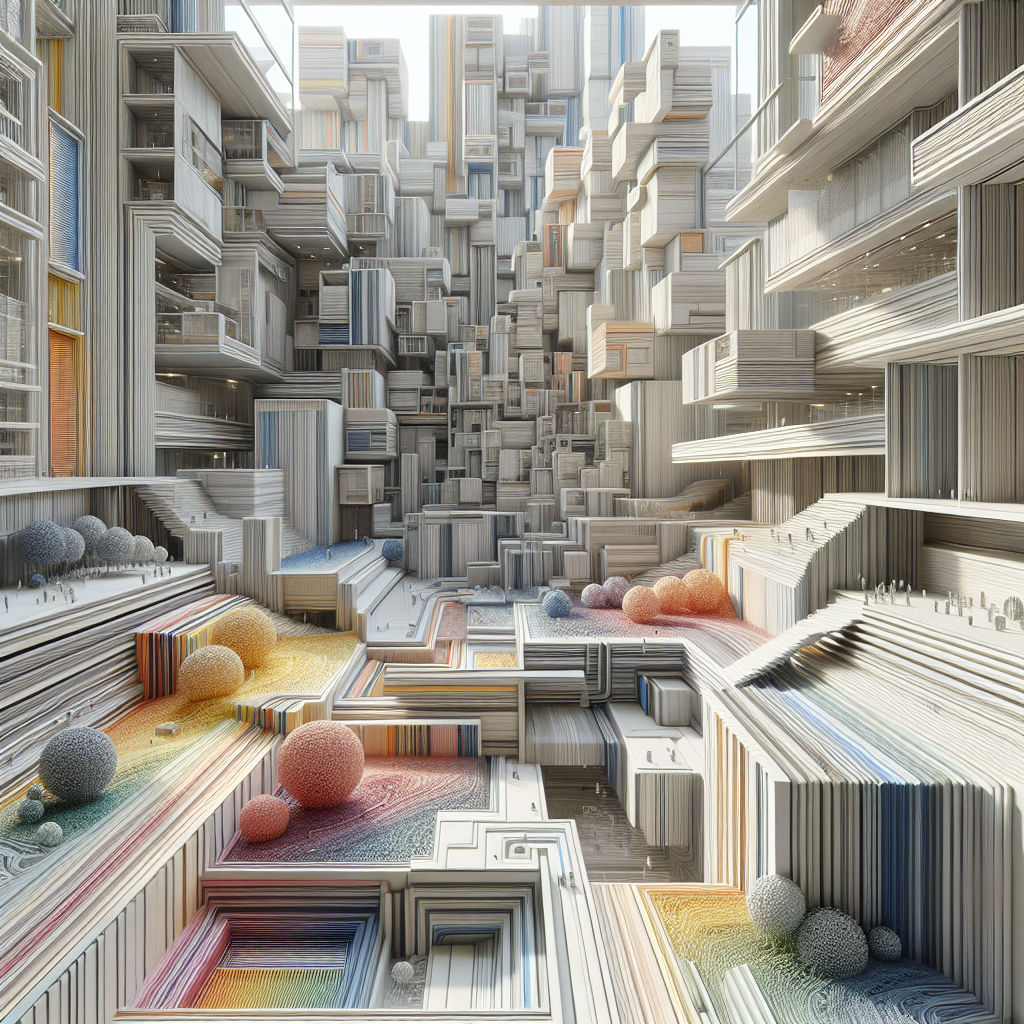
Moriyuki Ochiai Architects’ innovative projects, particularly the Crystalscape Beauty Salon in Tokyo and the Wire Mesh Tea Ceremony House, demonstrate a profound mastery of material layering and light interaction to create dynamic, responsive interiors. For AEC professionals, these works offer critical insights into how computational design and BIM can translate complex spatial concepts into buildable realities. By examining how Ochiai intertwines structural precision with atmospheric effects, architects and BIM coordinators can enhance their workflows for projects demanding sophisticated material systems and environmental responsiveness, moving beyond static models to capture the temporal qualities of space.
Technical Breakdown: Crystalscape’s Lattice and Wave System
The Crystalscape Beauty Salon exemplifies a meticulous fusion of structure and optics. Ochiai Architects engineered a three-dimensional compound system where planar grid objects form a white matrix, interspersed with three-dimensional lattice objects. This white lattice, featuring a gradation of white and wooden tones, serves as the primary structural substrate. Interwoven with this are metallic waves—reflective surfaces designed to evoke the graceful flow of vibrant hair. The critical innovation lies in their strategic arrangement: the circumvolutions of the metal waves increase in density within the hair-cutting zones, where natural light penetration is most significant. This configuration acts as a sophisticated reflector system, scattering subdued light as it bounces off the creases, creating a “mystical luminous crystal” effect across the ceiling. The structural interaction between these layers generates depth perception that varies dynamically with viewer position, demonstrating how parametric modeling in BIM platforms like Revit or Rhino can be used to simulate and optimize complex material interplay for specific spatial experiences.
Light, Moiré, and Permeability in the Tea Ceremony House
In stark contrast to the salon’s luminous focus, the Wire Mesh Tea Ceremony House reinterprets traditional Japanese architecture through industrial materials. Ochiai replaces solid enclosures with multiple layers of diamond-shaped wire mesh, creating permeable boundaries that redefine spatial enclosure. The core technical achievement here is the deliberate generation of moiré effects—visual interference patterns produced by overlapping grids. The project allows for precise control over wire type, thickness, density, and color, directly influencing light transmission, shadow casting, sightlines, and even airflow. This transforms the wire mesh from a passive element into an “active mediator between space and perception.” As viewers move through the space, the layered installation creates shifting optical depth and spatial ambiguity. Light patterns respond continuously to movement and viewpoint, effectively turning the structure itself into a dynamic sensor. For AEC professionals, this highlights the importance of material property databases within BIM (like those managed by partners at arena-cad.com) to accurately model how layered materials interact with environmental factors like light and motion, enabling predictive analysis of spatial perception.
BIM Workflow for Complex Material Assemblies
Translating Ochiai’s concepts into practice demands advanced BIM workflows capable of handling non-standard materials and complex assemblies. Key technical steps include:
- Parametric Material Definition: Creating detailed material families for the white lattice and metal waves in Revit, including parameters for density, circumvolution frequency, reflectivity values, and thermal properties, ensuring accurate environmental simulation.
- Nested Component Modeling: Representing the three-dimensional lattice structure within the planar grid using nested families or sub-models, maintaining hierarchy while allowing for localized adjustments based on function (e.g., increased wave density in specific zones).
- Lighting Analysis Integration: Utilizing Revit’s Insight or Enscape to model natural light penetration and simulate light scattering/reflection off the metallic surfaces, validating the design’s temporal qualities throughout diurnal and seasonal cycles.
- Moiré Simulation (Emergent): While true moiré simulation remains challenging in standard BIM, leveraging tools like Dynamo to generate overlapping wire mesh patterns and studying their visual impact through rendered views or VR previews is crucial for assessing the perceptual effects.
- Clash Detection & Fabrication Detailing: Employing Navisworks for clash detection on the intricate layered assemblies and using BIM models to generate fabrication drawings for the custom lattice and wave components, ensuring buildability. Enginyring.com’s engineering services could be vital here for resolving complex structural interfaces.
Material Innovation and AEC Performance
Ochiai’s projects underscore a significant trend: the rise of materials that transcend static aesthetics to become dynamic environmental regulators. The wire mesh, with its inherent porosity and tunability, manages airflow and visual privacy without sacrificing light or spatial connection. Similarly, the salon’s layered system acts as a sophisticated light-diffusing canopy, potentially reducing glare and enhancing occupant comfort in high-glare zones. This shifts the focus towards performance-driven material selection in BIM, where properties like reflectance, transmittance, porosity, and acoustic behavior (a factor noted in fiber artist collaborations like Milla Novo’s work) are modeled alongside structural requirements. BIM coordinators must integrate detailed material libraries that capture these performance characteristics, enabling whole-building analysis for energy efficiency, daylighting, and occupant well-being. Future AEC workflows will increasingly rely on such material intelligence to achieve both experiential and sustainability goals.
Practical Steps for Implementing Layered Material Systems
- Define Material Properties Early: Establish precise BIM material families with photometric (reflectance, transmittance), physical (density, thickness), and environmental (thermal, acoustic) parameters based on manufacturer data.
- Use Sub-Modeling for Complexity: Break down intricate assemblies like Ochiai’s lattice/wave system into manageable sub-models or nested families within the primary architectural model.
- Validate with Environmental Analysis: Integrate daylighting and energy analysis tools (e.g., Revit Insight, Ladybug) early to model the impact of material layering on light and thermal performance.
- Plan for Fabrication & Assembly: Detail connection points and sequencing in the BIM model, using it to coordinate fabrication and ensure buildability of complex layered elements.
- Leverage Visualization for Perception: Employ rendered images, VR walkthroughs, and physical models to communicate the dynamic visual effects (like moiré or light scattering) to clients and stakeholders.
Moriyuki Ochiai Architects’ work provides a compelling blueprint for AEC professionals seeking to push the boundaries of spatial experience through material and light. By integrating the principles of layered complexity, dynamic responsiveness, and performance-driven materiality into their BIM workflows, architects and engineers can create environments that are not only structurally sound but also deeply engaging and environmentally attuned. The challenge lies not just in modeling the complex geometries but in simulating and predicting the temporal, sensory qualities they produce, a task where advanced BIM and analysis capabilities become indispensable tools for realizing truly innovative architecture.