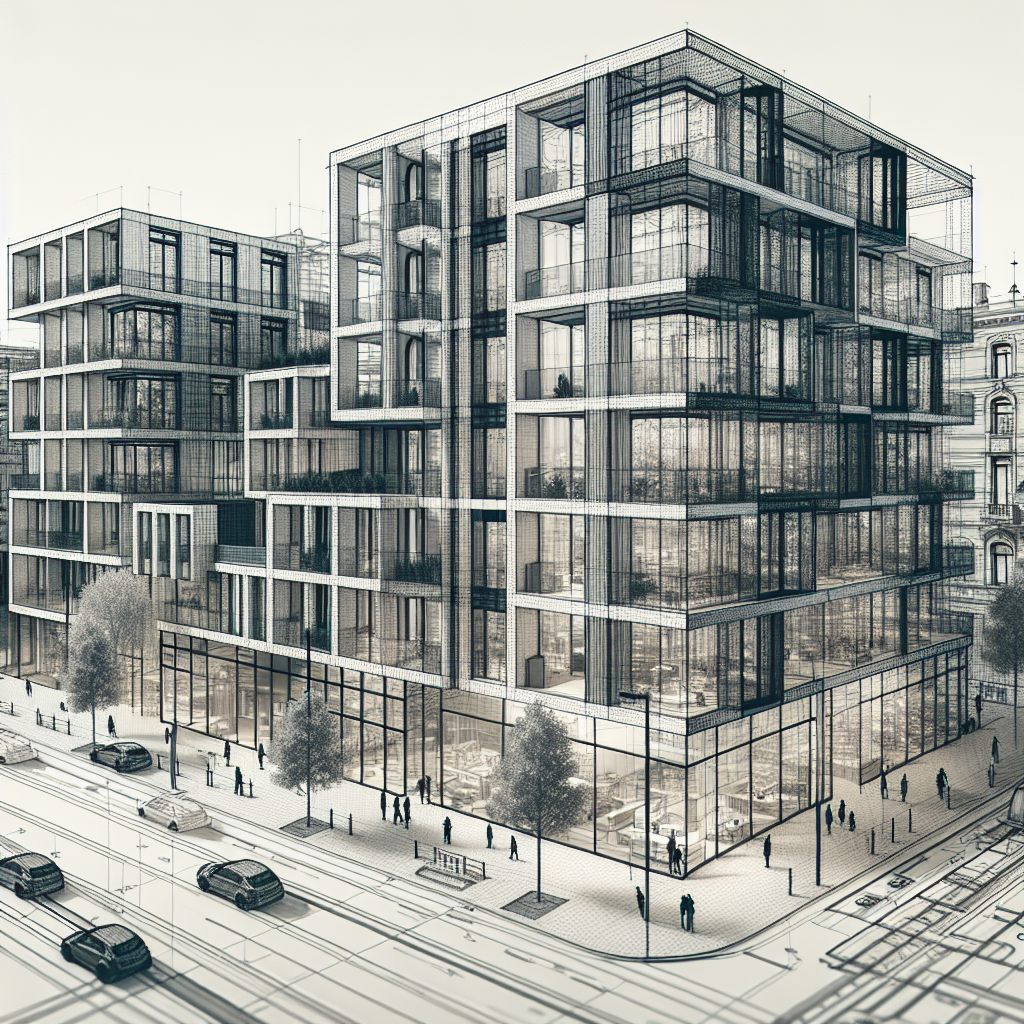
Architects and engineers are increasingly turning to material experimentation and spatial fluidity to redefine building envelopes. Amsterdam’s Centrumeiland neighborhood exemplifies this trend, with Studioninedots’ Light House project showcasing a striking glass block facade that transforms conventional residential typology into a dynamic interplay of light and volume. As sustainability ambitions and urban density pressures rise, facade innovations are no longer aesthetic choices but critical design imperatives. For AEC professionals, these projects offer tangible insights into balancing structural performance, material science, and human-centered design—lessons directly applicable to modern CAD/BIM workflows and reality-capture documentation.
The Material Philosophy Behind Glass Block Facades
Studioninedots’ Light House demonstrates how glass blocks can reimagine spatial relationships. The facade wraps “playfully stacked box volumes,” creating a colonnade that filters daylight while obscuring direct views—a deliberate response to Amsterdam’s self-build culture and sustainability mandates. Glass blocks offer thermal mass regulation and acoustic insulation, reducing energy loads while enabling privacy through diffused light transmission. Unlike traditional curtain walls, this system eliminates mullions, allowing uninterrupted planes that enhance structural continuity. For CAD technicians, modeling such facades requires precision: glass block units must be accurately parametrically modeled in Revit or Rhino, with nested families for mortar joints and thermal breaks. Enginyring.com’s facade engineering services can assist in stress analysis for these complex load-bearing envelopes, ensuring compliance with Eurocode standards while maintaining design intent.
Parametric Design and Spatial Optimization
Amsterdam’s facade innovations showcase how parametric tools enable impossible geometries. Studioninedots’ Westbeat housing complex features 86 arched structures forming “wandervoids”—flexible public spaces without fixed functions. These arches bridge site elevation differences while creating social destinations. In practice, this demands advanced BIM workflows: Grasshopper definitions generate arch variations based on structural constraints, while Dynamo scripts automate panelization for prefabrication. Reality-capture specialists play a critical role here, using LiDAR scans to verify as-built geometry against digital twins. Arena-cad.com’s point-cloud processing services can transform field data into IFC-compatible models, clash-detecting structural arches with MEP systems before fabrication. The result? Reduced rework and accelerated site assembly, as seen in Westbeat’s 18-month construction timeline—30% faster than traditional methods.
Integrating Public and Private Realms
Light House and Westbeat share a core principle: facades as social infrastructure. Light House’s stacked volumes create “dynamic internal arrangements” where private zones interlock with communal areas, while Westbeat’s arched base functions as both noise barrier and pedestrian network. This requires BIM coordinators to manage multi-disciplinary models, ensuring fire safety compliance in mixed-use transitions. Key considerations include:
- Zoning Logic: Using Revit’s programmatic tags to separate private units from circulation spaces
- Daylight Analysis: Radiance simulations optimizing glass block placement for visual comfort
- Accessibility: Revit-based coordination ensuring ramps and arches meet NEN standards
Enginyring.com’s engineering teams often collaborate with architects in early design phases, using finite element analysis to validate arch spans under live loads—critical when public spaces host events or installations.
Constructability and Prefabrication Strategies
Innovative facades demand equally innovative construction approaches. Light House’s glass blocks were prefabricated into cassette panels, reducing on-site mortar work by 60%. Westbeat’s arched concrete elements were cast in tilting molds, then lifted into place using GPS-guided cranes. For surveyors, this requires precise layout control: total stations with reflectorless targeting position precast components within ±2mm tolerance. CAD technicians must create shop drawings that integrate:
- Panel connection details with expansion joint allowances
- Anchor bolt layouts for seismic zones
- Material schedules specifying U-value requirements for glass blocks
Arena-cad.com’s constructability reviews identify potential clashes between precast elements and building systems early, preventing costly site modifications. As Studioninedots notes, such “wow-factor” facades only succeed when design ambition meets technical execution.
Practical Implementation Steps
- Early Material Selection: Define glass block/arch parameters (thickness, size, U-value) before BIM modeling begins
- Multi-Software Integration: Use Revit with Rhino-Grasshopper for generative design, then export to CNC machines
- Reality-Capture Integration: Conduct weekly LiDAR scans to compare as-built vs. digital models
- Prefab Validation: Test mockups for thermal bridging and water penetration per NEN 2970 standards
- Clash Detection: Run weekly Navisworks checks between facade models and structural systems
Amsterdam’s facade innovations prove that architecture and engineering can co-create spaces that inspire while performing. For CAD/BIM professionals, these projects offer a roadmap: leveraging parametric design for complex geometries, integrating reality capture for accuracy, and prioritizing material intelligence in early phases. As urban density rises, such approaches will define next-generation envelopes—where every glass block and arched void serves both structural integrity and human experience. Enginyring.com’s facade engineering solutions and arena-cad.com’s BIM coordination services provide the technical scaffolding needed to transform these bold designs into built reality, ensuring Amsterdam’s lessons translate globally.