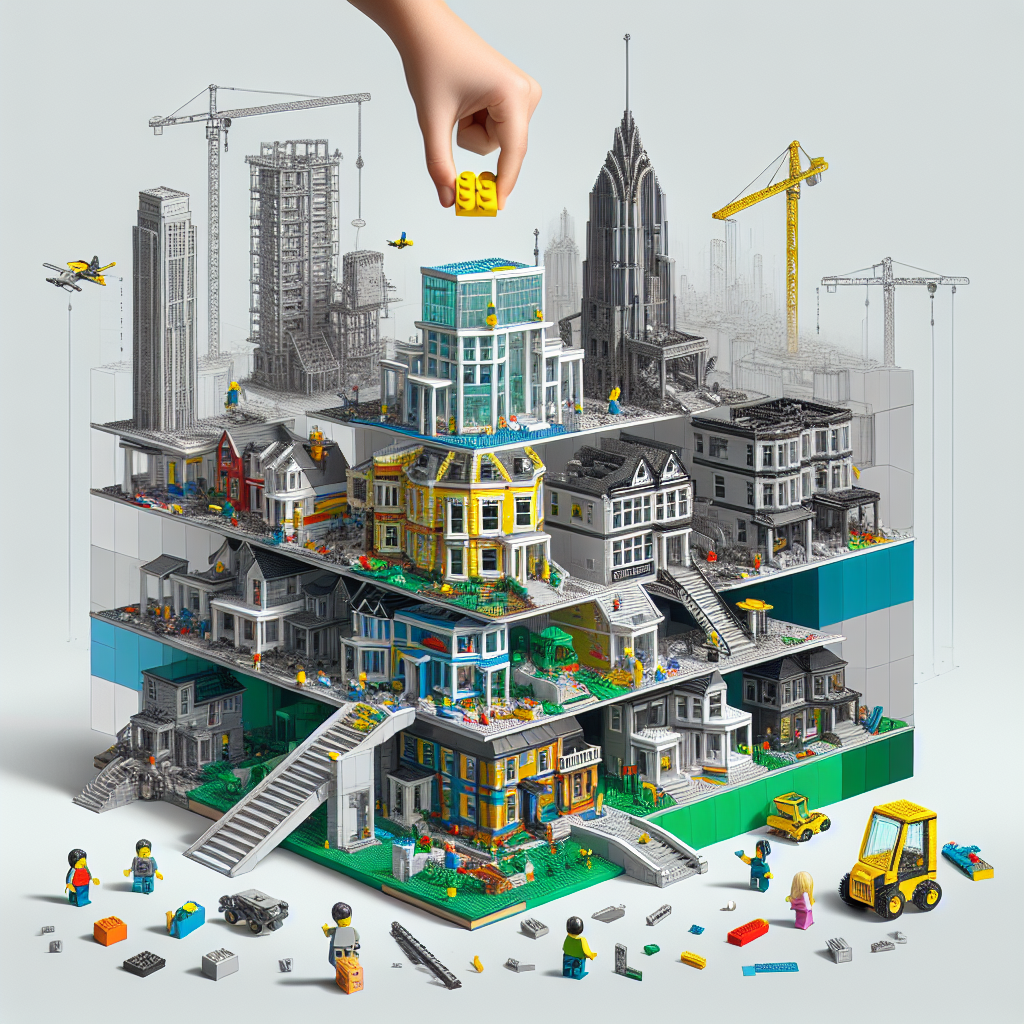
Remember the satisfying click of a Lego brick snapping perfectly into place? That childhood lesson in modular design is more relevant to your professional CAD and BIM workflow than you might think. In the world of mechanical, electrical, and plumbing (MEP) design, the principle of building complex systems from standardized, interoperable components is fundamental. This approach, mirroring the logic of Lego, is revolutionizing how we create and manage content within platforms like Autodesk Revit. Moving beyond static blocks or endlessly searching online repositories, the modern BIM professional is empowered to construct intelligent, parametric families—essentially, the “smart bricks” of digital construction—that drive efficiency, accuracy, and collaboration across the entire project lifecycle. This shift from passive geometry to active data is the cornerstone of a truly integrated AEC workflow.
The Modular Mindset: Applying Lego Logic to BIM Content Creation
The core genius of the Lego system lies not in any single brick, but in its modularity and strict interoperability. Every stud and tube is a precisely defined interface, allowing for infinite combinations from a finite set of parts. Translating this to BIM, the creation of mechanical equipment families in Revit demands the same disciplined, modular thinking. Instead of modeling a complex air handling unit (AHU) as a single, monolithic piece of geometry, a skilled technician breaks it down into its constituent logical parts: the casing section, the coil bank, the fan module, the filter rack. Each becomes a nested family with defined parametric relationships.
This methodology, as highlighted in the conceptual leap from “Lego Bricks to Revit Mechanical Families,” transforms the design process. It eliminates the need to hunt for the “almost right” family online or wait for a manufacturer update. By building from fundamental shapes and connectors, teams maintain full control over data structure, level of detail (LOD), and performance. This practice aligns perfectly with the kind of robust, standards-compliant content development championed by services like those at ENGINYRING.com, ensuring that every object in your model is not just a 3D shape, but a reliable carrier of critical project information.
Beyond Geometry: Building Intelligence into Every “Brick”
A basic Lego brick is a simple plastic form. A smart Lego brick, however, contains sensors, logic, and the potential for interaction. The parallel in BIM is the evolution from simple 3D CAD blocks to intelligent, data-rich Revit families (RFA files). An intelligent mechanical family doesn’t just represent the physical form of a VAV box; it contains embedded data for manufacturer, model number, electrical specifications, airflow ranges, connection types, and maintenance clearances.
This embedded intelligence is where the true power of modular BIM design unlocks. When you construct a family using a parametric framework—where dimensions, materials, and even visibility states are governed by parameters—you create a dynamic component. A single “Duct Flange” family, for instance, can be designed to adjust its geometry and bolt pattern based on a user-selected size and pressure rating parameter, much like selecting different Lego pieces from a bin. This ensures consistency, reduces errors, and automates schedule generation. Building this level of intelligence requires a methodical approach, one that focuses on robust parameter formulas, correct connector assignment, and adherence to project standards—a process that dedicated CAD/BIM services can significantly streamline.
The Collaborative Build: Standardization as the Universal Stud
Lego sets from different eras and themes seamlessly interoperate because of one unwavering standard: the brick clutch power and dimension. For BIM to deliver on its promise of collaborative, clash-free design, a similar commitment to standards is non-negotiable. When every team member builds mechanical families using the same template, naming conventions, and parameter libraries, the entire model becomes a coherent, interoperable system. A pipe valve created by one technician will connect perfectly to a pump created by another, with shared data definitions for flow rate and pressure drop.
This standardization is the antidote to the chaos of disparate content sources. It enables effective model federation, reliable data extraction for COBie or client-specific requirements, and smooth transitions between design phases. Establishing and maintaining these standards is a core competency for effective BIM coordination. It ensures that the modular components you build today will integrate flawlessly with the systems designed tomorrow, creating a single source of truth for construction and facilities management.
Practical Steps to Implement Modular BIM Design
Adopting a Lego-like approach to family creation requires planning and discipline. Here is a practical workflow to get started:
- Deconstruct the Equipment: Physically or from datasheets, break down the target mechanical equipment into logical, repeatable sub-assemblies.
- Define the Parameter Framework: Before modeling, list all required type and instance parameters (e.g.,
Length,Width,ConnectorSize,ServiceType). Plan the relationships between them. - Build the Nested Skeleton: Create simple, clean “skeleton” families for each sub-assembly. Use reference planes and lines as the foundational “studs and tubes” for parametric control.
- Assemble with Connectors: Nest the skeletons into a host family. Assign and configure the correct MEP connectors (duct, pipe, electrical), defining their system classifications and flow directions.
- Test Rigorously: Load the family into a test project. Validate all parameters, check connector behavior in systems, and verify performance at different LODs.
Conclusion
The journey from a pile of Lego bricks to a finished model is one of creativity governed by logic. In the AEC industry, this translates directly to the practice of building intelligent, modular BIM content. By embracing this mindset, architects, engineers, and technicians move beyond being passive users of generic content to becoming active creators of precise, data-driven design tools. This shift enhances control, improves collaboration, and ultimately leads to more efficient and accurate construction documentation. The principles are timeless; only the tools have evolved, empowering us to build our digital world with the same satisfying precision we mastered as children.