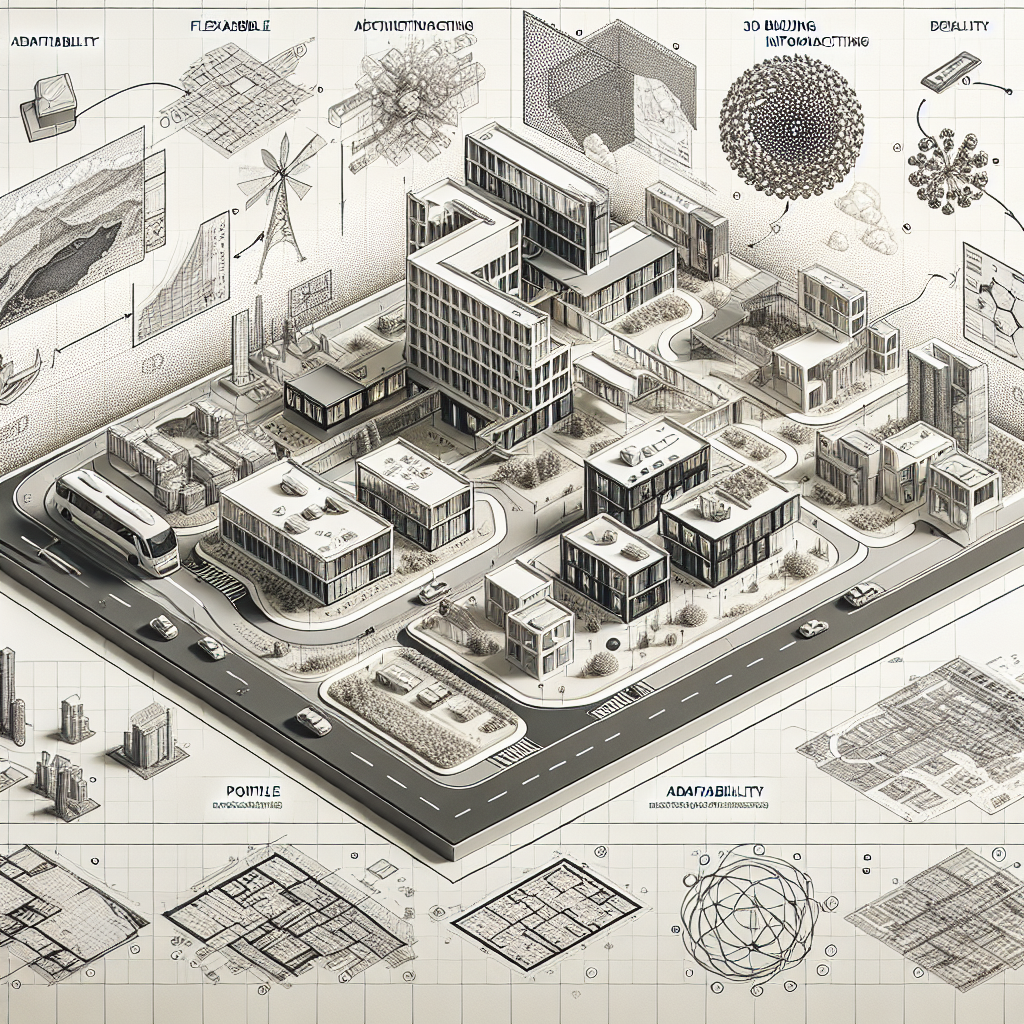
In an era of rapid urbanization, shifting workplace dynamics, and evolving societal needs, AEC professionals are increasingly tasked with creating spaces that transcend traditional boundaries. The concept of “architecture for slackers” – not about laziness, but about designing buildings with inherent flexibility – offers a powerful solution to contemporary challenges. This approach prioritizes adaptable spaces that respond organically to changing functions rather than imposing rigid prescriptions. By embracing programmatic slack, opportunistic attachments, and modular systems, architects and engineers can create more resilient, sustainable, and responsive environments. As construction technologies advance, leveraging CAD/BIM tools becomes essential to realizing these innovative design strategies that serve multiple purposes across time.
Designing for Multiple Lifespans: Programmatic Slack in Modern Architecture
The most forward-thinking buildings today are those designed with “programmatic slack” – spaces intentionally created to support diverse activities rather than single, fixed uses. This approach rejects the over-prescriptive model of traditional architecture in favor of environments that quietly facilitate life’s unfolding possibilities. As noted in contemporary design discourse, buildings succeed “by taking a step back,” allowing inhabitants to define spatial relationships rather than having them scripted by the designer. This slack manifests through generous open areas, passive environmental strategies, and circulation routes that avoid rigid programming, creating conditions for spontaneous interaction and use.
From a technical standpoint, implementing programmatic slack requires a shift from compartmentalized planning to fluid spatial zoning. In Revit 2023, for instance, architects can create adaptive component families that reconfigure based on user needs, while Dynamo scripts enable generative design solutions for multi-use spaces. The therapeutic performing arts center transforming a 1950s temple exemplifies this principle, where the structure’s inherent flexibility supports diverse therapeutic activities without requiring constant physical modification. For BIM coordinators, modeling such spaces involves developing flexible MEP systems that can serve multiple functions, using shared parameters to track equipment that might serve different zones interchangeably.
Opportunistic Attachments: Parasitic Architecture as a Strategic Intervention
Parasitic architecture represents a pragmatic response to urban constraints, demonstrating how thoughtful additions can breathe new life into existing structures without full-scale demolition. These interventions range from Michael Rakowitz’s paraSITE inflatable shelters that attach to building exhaust vents, providing low-impact housing solutions, to permanent plywood extensions that transform underutilized building surfaces. What sets these approaches apart is their opportunistic nature – they capitalize on existing infrastructure and unclaimed space, whether for social impact (homelessness solutions) or programmatic expansion (restaurant pods).
For CAD technicians modeling such projects, precision is paramount. Reality capture techniques like LiDAR scanning (Trimble X7) and photogrammetry (DJI Phantom 4 RTK) create accurate point clouds of host buildings, allowing designers to identify attachment points and structural interfaces with millimeter accuracy. The CUBE restaurant, which traveled across Europe attaching to various structures, illustrates how temporary parasitic architecture can maintain high material quality while adapting to different contexts. When modeling these attachments in AutoCAD Civil 3D, engineers must analyze load distribution on existing structures, often requiring finite element analysis (FEA) to ensure stability without compromising the host building’s integrity.
Adaptive Reuse: Converting Vacant Offices into Housing Solutions
As remote work reshapes urban landscapes, converting vacant office buildings into residential units presents a critical opportunity to address housing shortages while reducing construction waste. Calgary’s Cornerstone project exemplifies this trend, transforming a 129,000 square foot office building with a complete facade overhaul and balcony additions to create contemporary apartments. Such conversions leverage existing structural frameworks, foundations, and utilities – significantly embodied carbon compared to new construction – while repositioning prime downtown locations for residential use.
BIM coordinators play a vital role in these transformations, creating LOD 500 models that document existing conditions and propose new systems. Enginyring’s structural analysis services are particularly valuable here, assessing the capacity of existing floor slabs for residential loads and identifying necessary reinforcements. The process involves coordinating with local authorities to navigate code compliance, as residential occupancy requirements differ substantially from office classifications. Surveyors must conduct precise dimensional verification of existing spaces to identify structural elements concealed within partitions, while reality capture specialists document facade conditions to plan restoration versus replacement strategies.
Modular and Portable Systems: Expanding Architectural Possibilities
The most adaptable future buildings will likely incorporate elements of portability and modularity, allowing spaces to expand, contract, or relocate as needs evolve. Molo’s softhousing demonstrates this philosophy through honeycomb-expandable walls that transform small spaces with vaulted ceilings, creating intimate yet flexible enclosures. Similarly, portable structures like Tejlgaard & Jepsen’s Dome of Visions – functioning simultaneously as greenhouse and performance space – challenge conventional notions of permanence. The Italian firm’s Blob vB3 takes this further, using curved walls to maximize limited interior space while remaining fully transportable.
CAD/BIM workflows enable these innovations through parametric modeling in tools like Grasshopper, where designers can test expansion mechanisms and material behaviors. For surveyors and reality capture specialists, scanning portable units requires specialized techniques to capture both deployed and stowed configurations. The Transition unit highlights the social impact potential, using portable architecture to address housing needs in underprivileged communities. When modeling such systems in Revit, families must include parameters for different states (transported vs. assembled), and assembly documentation must be particularly robust for non-permanent structures.
Practical Implementation Steps for Adaptive Design
- Conduct Multi-Scenario Programming: Identify at least three potential building uses during schematic design to inform flexible zoning strategies.
- Employ Reality Capture: Use terrestrial LiDAR scanning (minimum 5mm accuracy) and photogrammetry to document existing structures before interventions.
- Develop Parametric BIM Models: Create adaptive component families in Revit or Grasshopper that allow spatial reconfiguration without model reconstruction.
- Integrate Analysis Tools: Use Enginyring’s structural analysis services to verify load-bearing capacity for multiple occupancy scenarios early in design.
- Document Assembly Protocols: Create detailed CAD drawings showing attachment points and expansion sequences for modular systems.
The future of architecture lies not in monumental statements but in quiet generosity – spaces that support life without constraining it. By embracing programmatic slack, parasitic interventions, adaptive reuse, and modular systems, AEC professionals can create environments that serve evolving societal needs with minimal environmental impact. The technical realization of these visions demands mastery of advanced CAD/BIM workflows, from reality capture to parametric modeling, ensuring that adaptable designs remain structurally sound and code-compliant. As demonstrated by projects worldwide, the most resilient buildings are those that anticipate change, offering flexibility without sacrificing performance. Professionals seeking to implement these strategies can explore specialized tools and services at arena-cad.com for reality capture and modeling solutions, while Enginyring.com offers critical engineering analysis for complex adaptive reuse projects. In this shifting landscape, the ability to design for adaptation is no longer optional – it’s fundamental to creating sustainable, future-ready built environments.