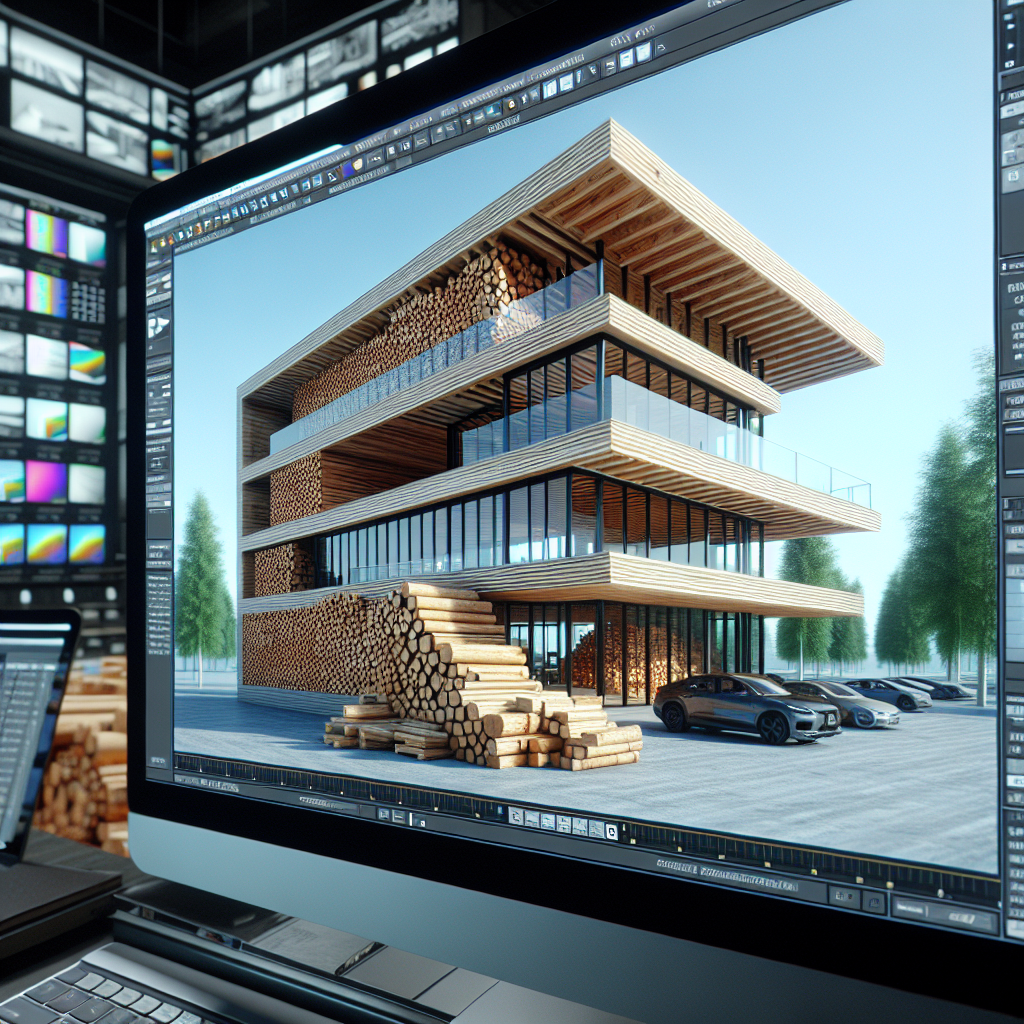
In Nagoya, Japan, 1-1 architects have demonstrated a compelling solution to construction waste by transforming decades of stockpiled timber into a layered house and office structure. This project showcases how architects can turn surplus materials into architectural assets while reducing embodied carbon and resource depletion. For AEC professionals, this case study highlights both the opportunities and complexities of integrating salvaged timber into contemporary design. As the industry faces increasing pressure to adopt circular economy principles, leveraging digital tools like BIM and CAD becomes essential to document, analyze, and materialize unconventional resources efficiently. The challenge lies in adapting design workflows to accommodate non-standard materials while maintaining structural integrity and project viability.
The Environmental Imperative of Material Reuse in Architecture
The construction industry generates approximately 30% of global waste annually, with timber accounting for significant volume in regions with abundant forestry. By repurposing stockpiled timber—often sitting in warehouses for decades due to changing building standards—1-1 architects addressed both environmental and economic concerns. This approach drastically reduces the need for virgin timber, lowering deforestation rates and sequestering carbon stored in existing materials. For BIM coordinators and project managers, this strategy aligns with ISO 14040 lifecycle assessment standards by minimizing extraction, processing, and transportation emissions. The Nagoya project exemplifies how material reuse can achieve LEED v4.1 Materials and Resources credits, particularly MRc3 (Building Reuse) and MRc4 (Recycled Content). As sustainable construction becomes mandatory in jurisdictions like the EU and California, such projects offer replicable models for waste reduction without compromising design quality.
Technical Challenges of Using Stockpiled Timber
Repurposing decades-old timber introduces significant technical hurdles that demand rigorous digital workflows. Stockpiled timber often suffers from moisture content variations (ideally 12-18% for structural use), potential insect damage, and unpredictable strength properties. Unlike standardized lumber, salvaged materials require individual grading using non-destructive testing (NDT) methods like stress wave timers or resistograph drilling. BIM technicians must model each timber element’s unique properties, assigning custom parameters in Autodesk Revit 2023 or ARCHICAD 26 for structural analysis. The Nagoya project likely involved sorting timber by visual grading (per ASTM D245) and digital scanning to map knots and grain orientation. For CAD technicians, this translates to creating parametric families that adapt to irregular dimensions, while structural engineers perform finite element analysis (FEA) in software like STAAD.Pro to ensure load capacity meets IBC 2021 requirements. Without digital documentation, such projects risk structural failures and cost overruns.
Leveraging BIM and CAD for Salvaged Material Integration
BIM enables precise coordination between irregular timber elements and structural systems, turning a liability into a design opportunity. In the Nagoya project, 1-1 architects likely used Revit’s massing tools to develop a “layered” facade that accommodated varying timber lengths, creating both aesthetic and structural advantages. Arena CAD’s BIM coordination services would facilitate clash detection between timber frames and MEP systems, while ENGINYRING’s structural engineers could run energy modeling in IESVE to optimize thermal performance. Digital workflows allow timber properties (e.g., modulus of elasticity, density) to be linked directly to analysis models, ensuring compliance with Eurocode 5 or NDS 2021. For surveyors and reality-capture specialists, integrating terrestrial laser scans (TLS) from Leica RTC360 into point cloud workflows in AutoCAD Civil 3D enables 1:1 digital twins of salvaged materials. This data-driven approach reduces material waste by 15-20% compared to traditional methods, as seen in the Nagoya project’s efficient timber utilization.
Reality Capture as a Foundation for Material Documentation
Accurate documentation of stockpiled timber is non-negotiable for successful reuse. The Nagoya project began with photogrammetry and LiDAR scans of decades-old timber piles, creating georeferenced point clouds in CloudCompare. These digital records informed material classification, identifying usable sections while marking compromised areas for exclusion. CAD technicians then converted validated scans into 2D layouts in AutoCAD 2023, nesting irregular shapes to minimize offcuts. Arena CAD’s reality-capture services provide similar workflows for existing-material projects, enabling architects to develop adaptive design strategies. For example, timber with visible defects might be relegated to non-structural applications like cladding or partitions, while high-grade elements support primary loads. This digital triage process—powered by tools like Bentley ContextCapture—ensures salvaged materials meet ASCE 7-16 safety standards while maximizing aesthetic potential through digital cataloging.
Practical Implementation Steps
- Inventory Assessment: Conduct TLS scans of stockpiled timber and catalog dimensions/defects using BIM parameters.
- Digital Material Mapping: Assign structural properties (e.g., Fb, E) in Revit families based on ASTM D638 testing.
- Adaptive Modeling: Develop parametric component families that auto-adjust to timber dimensions during design iterations.
- Compliance Integration: Run clash detection and structural analysis in Navisworks/STAAD.Pro to validate code compliance.
- Phased Documentation: Update BIM models with material revisions during construction to maintain accuracy.
The Nagoya project underscores a transformative shift in AEC: material reuse isn’t just sustainable—it’s economically viable when paired with digital expertise. By documenting, analyzing, and designing through BIM and CAD workflows, professionals can transform surplus timber into high-performance architecture. For teams implementing similar projects, Arena CAD’s BIM coordination services and ENGINYRING’s structural analysis capabilities provide the technical backbone needed to navigate material irregularities while ensuring safety and efficiency. As circular construction becomes industry standard, the fusion of salvaged resources with digital innovation will define next-generation sustainable design.