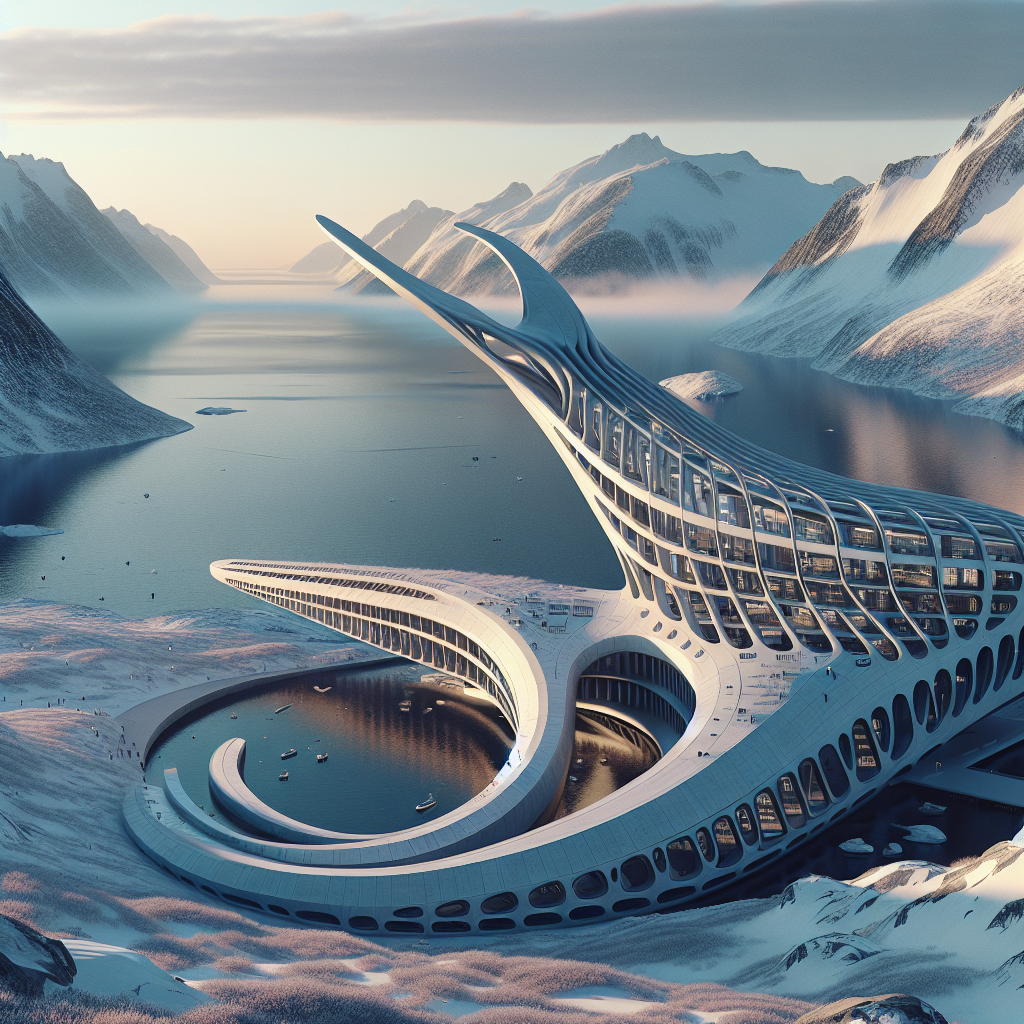
Dorte Mandrup’s The Whale museum currently rising from Andenes, Norway, represents a masterclass in environmentally responsive design. Located 300 kilometers north of the Arctic Circle, this 4,500 sqm cultural facility is not merely a building but a sculptural continuation of the dramatic coastline it inhabits. Its defining feature – a sinuous, parabolic roof mimicking a beached whale – is transitioning from concept to reality through advanced structural engineering and meticulous construction techniques. This ambitious project, funded partly by the Norwegian government, demonstrates the critical intersection of complex geometry, site-specific challenges, and digital fabrication in contemporary AEC practice.
Form Finding and Structural Expression
The Whale’s most striking characteristic is its broad, curved rooftop, designed as a “soft hill” emerging from the rocky shore. This sculptural form is achieved through a layered construction method clearly visible in recent progress images. A series of prominent steel ribs trace the complex arc of the roof structure, revealing how the intricate geometry is being built incrementally. These ribs are essential for maintaining the integrity of the parabolic curve while supporting the concrete shell. The building’s approach to the landscape is direct; it’s conceived as a terrain extension, a surface meant to be walked upon and experienced rather than viewed as a separate object. This integration is further enhanced by the careful development of paths, platforms, and viewpoints that connect the museum directly with its surroundings, guided by landscape architect Marianne Levinsen Landskab. The project won an international competition, showcasing Dorte Mandrup’s renowned capability in crafting architecture for sensitive sites demanding deep contextual understanding.
Environmental Integration: Snow Load Management
Working 300km north of the Arctic Circle presents significant environmental challenges, particularly heavy snow accumulation. The Whale’s design directly addresses this reality. The roof’s gentle, continuous slope is a functional necessity, not just an aesthetic choice. It allows snow and precipitation to slide naturally across the surface towards designated drainage points, preventing dangerous buildup that could compromise structural integrity or create hazardous conditions. This pragmatic approach aligns with Dorte Mandrup’s philosophy of designing with the environment, not against it. The Gulf Stream’s moderating influence is acknowledged, but the structure must withstand harsh Arctic conditions. The concrete and steel construction, combined with this calculated geometry, ensures longevity and safety in a climate where extreme weather is常态. This integration of form and environmental response is a key lesson for engineers and architects working in similarly challenging locations.
BIM Coordination and Complex Geometry Execution
Realizing *The Whale*’s complex parametric forms demands sophisticated BIM (Building Information Modeling) workflows. The project’s sinuous surfaces and intricate structural ribs are impossible to coordinate accurately using traditional 2D methods alone. BIM is essential for integrating architecture, structural engineering (handled by Thornton Tomasetti), MEP (Mechanical, Electrical, Plumbing), and the specialized exhibition design by JAC Studio into a single, coherent model. This digital environment allows clash detection, precise quantity takeoffs for the complex steelwork and concrete forms, and facilitates communication between all parties – from the architects in Copenhagen to the fabricators and construction teams on-site in Andenes. The management of this level of geometric complexity requires robust platforms like Autodesk Revit or similar, capable of handling NURBS surfaces and complex families. For professionals at firms like [arena-cad.com], which specializes in advanced BIM coordination and modeling services, projects like The Whale exemplify the critical role of technical expertise in translating ambitious design intent into buildable reality.
Cultural Mission and Architectural Sensitivity
Beyond its technical prowess, The Whale embodies a profound cultural mission. The museum aims to foster a deep connection between humans and the marine ecosystem, particularly the migrating whales that frequent the nearby deep-sea valley. It houses exhibition spaces, offices, a café, and a store, all curated to educate and inspire visitors about ocean conservation. Dorte Mandrup’s design approach, described as “sensory architecture,” is crucial here. The building itself, emerging as if from the earth, creates a tangible link to the landscape and the underwater world it overlooks. This sensitivity extends to construction practices and material choices, aiming for an architecture that is environmentally, economically, and socially sustainable. The project’s goal is to strengthen northern Norway as a destination while creating a positive ripple effect for local businesses, demonstrating that large-scale infrastructure can be a catalyst for community and environmental stewardship. This holistic vision requires close collaboration between architects, engineers, contractors, and local stakeholders, a process where [enginyring.com], with its integrated engineering and construction services, could provide valuable support.
Practical Steps for Integrating Complex Geometry
- Parametric Early Engagement: Use parametric modeling software early in design to explore form, function, and structural implications collaboratively.
- Robust BIM Foundation: Implement a comprehensive BIM protocol from inception, defining LOD (Level of Development) standards and model structure for all disciplines.
- Clash Detection & Coordination: Schedule regular clash detection sessions using the federated BIM model to resolve conflicts between systems before site fabrication.
- Specialized Fabrication Modeling: Develop detailed fabrication models (e.g., for curved steel ribs or complex concrete formwork) integrated with the main BIM.
- Site Tolerance Analysis: Analyze geometric tolerances during design and manufacturing to account for Arctic construction challenges and ensure assembly accuracy.
Conclusion
Dorte Mandrup’s The Whale is a landmark project showcasing how advanced digital tools, deep environmental understanding, and a commitment to cultural mission can converge to create architecture that resonates powerfully with its context. Its construction in Norway’s Arctic landscape pushes boundaries in structural expression, environmental integration, and BIM coordination. For AEC professionals, it offers invaluable lessons in translating complex, sculptural designs into buildable reality while respecting the unique demands of sensitive sites. As the steel ribs form and the concrete curves take shape, The Whale stands as a testament to the technical innovation and collaborative spirit required to realize visionary architecture in the world’s most challenging environments. Its completion is eagerly awaited, promising not just a new museum, but a new paradigm for how we build within nature.