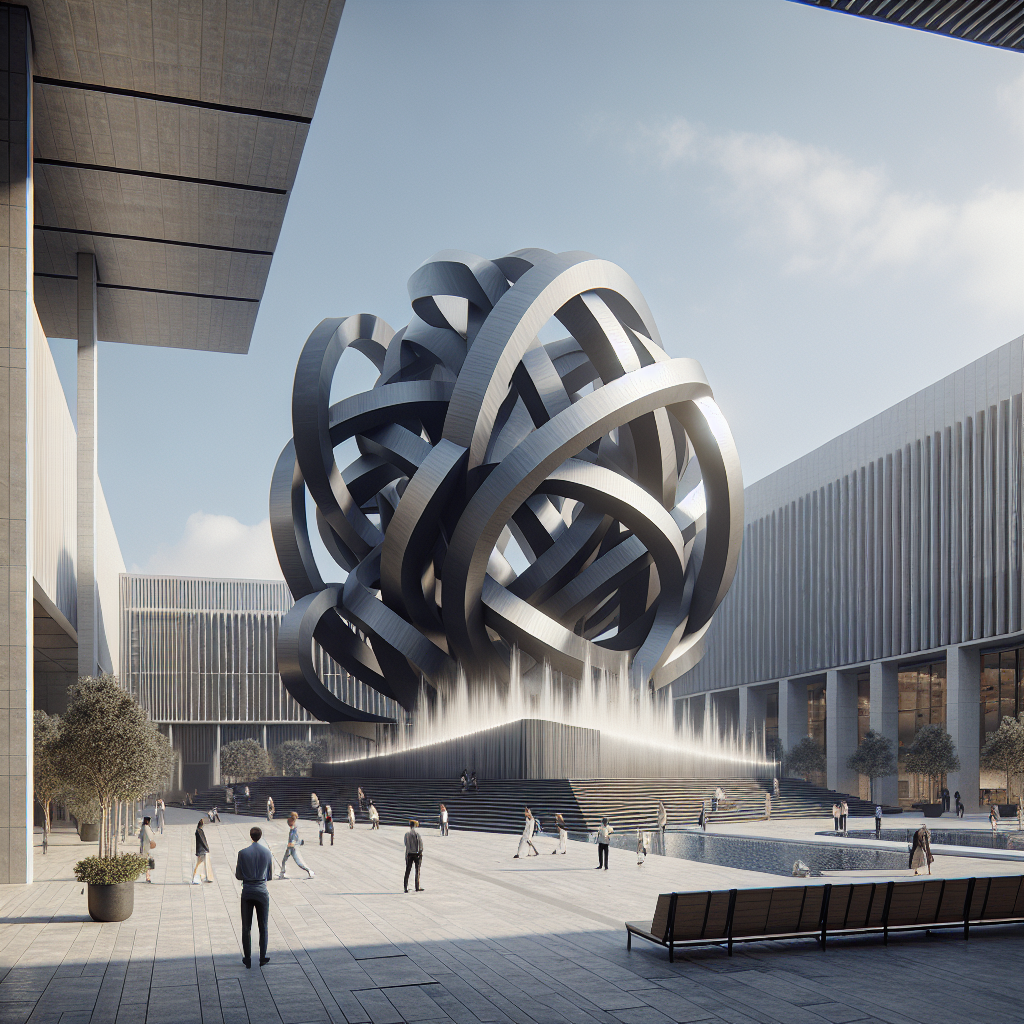
The 61st Venice Biennale and recent global art exhibitions are redefining public engagement through technologically advanced, large-scale installations. These projects—from JR’s woven tapestries to industrial robot performances—demonstrate how digital tools are bridging creative expression and built environments. For AEC professionals, these innovations offer critical insights into material translation, sustainable integration, and automation. By analyzing how artists translate digital files into physical realities, we uncover parallels in BIM workflows, reality-capture documentation, and parametric design that can enhance construction efficiency and community-focused outcomes.
Translating Digital Design to Physical Reality
JR’s Il Gesto tapestry at Palazzo Ca’ da Mosto exemplifies the challenges of scaling digital art to physical form. The 4.3m × 7.8m textile required 600 hours of weaving to convert JR’s photographic digital file into a woven medium, reinterpreting Paolo Veronese’s The Wedding at Cana as a social commentary. This process mirrors BIM workflows where 3D models inform fabrication. For instance, similar digital-to-analog translation occurs in Arena CAD’s BIM coordination tools, where Revit or ArchiCAD models drive CNC machining or 3D printing. The technical precision needed to maintain visual fidelity across scales—from digital renderings to woven threads—parallels the meticulous tolerances required in structural steelwork or curtain wall systems. Master weaver Giovanni Bonotto’s collaboration highlights how craftsmanship and digital design can coexist, a lesson applicable to hybrid construction methods integrating prefabricated components with on-site adjustments.
Sustainable Materials and Community Narratives
Serge Attukwei Clottey’s Time and Chance at the Venice Architecture Biennale repurposes recycled plastic gallon containers (Kufuor Gallons) into a suspended tapestry, visualizing Ghana’s water scarcity crises. This approach resonates with AEC’s push toward circular-economy practices. Architects and BIM coordinators can leverage similar strategies by integrating material databases in software like Navisworks to track recycled content in Revit models. The narrative power of Clottey’s installation—transforming waste into a communal art piece—aligns with Enginyring’s community-focused BIM services, which use digital storytelling tools to engage stakeholders in infrastructure projects. When specifying materials, professionals should adopt life-cycle analysis protocols, as demonstrated by Fondazione Bonotto’s 600-hour research phase, to ensure ethical sourcing and waste reduction in temporary or permanent installations.
Automation and Robotics in Art and Construction
Sun Yuan and Peng Yu’s Can’t Help Myself (2019 Venice Biennale) featured an industrial robot programmed to contain a viscous red fluid, blurring the line between performance and automation. This mirrors autonomous construction systems like bricklaying robots or laser-guided concrete formwork. For project managers, the takeaway is clear: robotics require precise digital programming akin to robot path planning in tools like Arena CAD’s Reality Capture modules, which integrate point clouds from laser scanning or photogrammetry (Agisoft Metashape, ContextCapture) to guide automated equipment. However, unlike JR’s static tapestry, dynamic installations demand fail-safes—akin to safety protocols in robotics-enabled construction sites. Such automation can optimize repetitive tasks, from panel installation to quality control, but require rigorous clash detection in BIM models to prevent operational errors.
Temporary vs. Permanent Installations: Digital Flexibility
JR’s La Nascita in Milan (April-May 2024) uses printed aluminum scaffolding panels to create a temporary rock facade, contrasting with *Il Gesto*’s permanent textile. Both rely on digital adaptability: *La Nascita*’s scaffold-based design allowed rapid assembly/disassembly using local materials, while Il Gesto required permanent anchoring within Palazzo Ca’ da Mosto. This dichotomy reflects BIM’s role in phasing: temporary structures (e.g., event stages) benefit from modular, reusable components modeled in Revit, while permanent infrastructure demands durability analysis. Tools like Arena CAD’s 4D scheduling can simulate installation sequences for both scenarios, optimizing logistics. Surveyors and reality-capture specialists should document such installations using terrestrial LiDAR (Faro Focus, Leica RTC360) to inform future projects, as these digital records become part of the built environment’s collective memory.
Practical Steps for AEC Professionals
- Digital-to-Physical Workflows: Use BIM software (Revit, ArchiCAD) to create fabrication-ready models for artists or contractors.
- Material Sustainability: Audit material origins via digital databases; prioritize recyclable/renewable resources.
- Robot Integration: Validate robotic path plans with clash detection (Navisworks) and safety protocols.
- Temporary Design: Model modular, reusable components for phased projects.
The convergence of art and construction reveals a future where digital design, sustainable practices, and automation define public spaces. Projects like JR’s tapestries and Clottey’s recycled tapestries prove that technology can amplify community narratives and ecological responsibility. By adopting these principles—leveraging BIM for translation, robotics for precision, and circular materials—AEC teams can create structures that are not only structurally sound but also culturally resonant. As Enginyring and Arena CAD continue to advance digital workflows, the line between art and architecture will increasingly blur, enriching our built environments with innovation and humanity.